
How Zenith Built Its New Watch Line Around a Historic Chronometer
Returning to Zenith 's manufacture in Le Locle, the multicolored Felipe Pantone façade from our 2023 visit has been replaced. In its stead stands a striking trompe-l’oeil mural mirroring the manufacture’s historic exterior walls — complete…
Returning to Zenith's manufacture in Le Locle, the multicolored Felipe Pantone façade from our 2023 visit has been replaced. In its stead stands a striking trompe-l’oeil mural mirroring the manufacture’s historic exterior walls — complete with rows of azure windows, subtle brick pattern and the iconic "G.F.J." lettering honoring founder Georges Favre-Jacot. Unveiled last spring to mark Zenith's 160th anniversary, this architectural facelift arrived just a month before the brand revealed its latest high-craft direction at Watches and Wonders.
The celebratory momentum naturally carried into the annual watch fair, where Zenith officially debuted its G.F.J. line. Named after the Maison’s visionary founder, the G.F.J. collection serves as the newest dress watch model in the brand’s modern roster, marking a refreshing shift for a catalog heavily dominated in recent years by the luxury sports watches from the Defy line.
“In our lineup, we have always had a timeless, elegant, dressy collection,” Romain Marietta, Zenith’s Chief Products Officer, tells Hypebeast. “Until last year, that was the Elite Collection. It was our entry-level segment for the manufacture. However, as a brand focused on value proposition rather than mass market volume - we produce fewer than 20,000 watches a year compared to the millions produced by others - we realized we needed to elevate our core values.” As the long-standing Elite collection is gradually phased out, the G.F.J. steps up as the brand’s new signature expression of elegant haute horlogerie.
“As a brand focused on value proposition rather than mass market volume, we realized we needed to elevate our core values.” - Romain Marietta, Chief Products Officer at Zenith
To anchor this rebirth, Zenith resurrected its archival holy grail: the legendary Calibre 135. Laurence Bodenmann, Zenith’s Head of Heritage, describes it as an "icon of watchmaking at large," and a movement within the Maison’s 160-plus years of history that could rival the significance and fame of its prized El Primero. Originally conceptualized in 1949 by constructor Ephrem Jobin, the movement was a technical masterpiece engineered specifically to dominate the Neuchâtel Observatory chronometry trials. Its physical architecture dictates its very name: a diameter of 13 lignes - literally the maximum allowable size for the wristwatch category in competition - paired with a 5mm height.
“[Jobin] wanted to bring the precision you get in a pocket watch - specifically the extra-large balance wheel - into a wristwatch,” Bodenmann explains. “He designed this movement with an extra-large balance wheel to provide more inertia to the rate, resulting in more regularity and precision.” And it is this precise, oversized wheel that makes the Calibre 135 instantly recognizable.
“There is a romantic feeling to winding [a watch] by hand, much like a pocket watch.” - Laurence Bodenmann, Head of Heritage at Zenith
To this day, Zenith remains the undisputed holder of the most chronometry awards in watchmaking history, having amassed an unparalleled 2,333 prizes. The Calibre 135 alone accounts for more than 10% of that legendary record, holding 235 internal titles. Though the industry's sweeping mid-century shift toward automatic movements forced the caliber into a 60-year retirement in 1962, a monumental mechanical homecoming was sparked in 2022 through a landmark three-way collaboration.
“The idea actually came from the Phillips,” Bodenmann says, recounting how the auction house initiated the project. “They asked us, ‘What are you doing with the 135?’ It's so emblematic, and every time a vintage 135 surfaces, people are incredibly excited.” This then led to the three-way project between Phillips, Zenith and the esteemed independent watchmaker Kari Voutilainen, resulting in the restoration and casing of ten ultra-rare, observatory-grade 135-O calibers that won historical Neuchâtel trials between 1950 and 1954.
Building on that success, Zenith chose to install a modernized variant of the mechanical legend as the beating heart of the production G.F.J. models. “Today, what do we need an automatic for in this context? Chronographs with high frequency are great, but for a highly precious, three-hand watch that you don't wear every day, you are going to have to set it anyway,” Bodenmann notes. “There is a romantic feeling to winding it by hand, much like a pocket watch.” While boosting the power reserve to a modern three days, Zenith meticulously preserved the original caliber's historical tenets - including a rare Breguet-type spiral overcoil that remains highly uncommon in modern movements today - proving that manual winding is still our most romantic interaction with time.
“Designing [the G.F.J.] was incredibly challenging because it’s a three-hand watch… Finding a strong character for a three-hander is tough.” - Sébastien Gobert, Creative Director at Zenith
For the G.F.J., translating that mechanical genius to the wrist required a design language just as sophisticated as its movement. Sébastien Gobert, Zenith’s Creative Director, recalls the immense difficulty of the task: “Designing this piece was incredibly challenging because it’s a three-hand watch. It is much easier to design a chronograph where the dial is full of indications. Finding a strong character for a three-hander is tough.” Yet, the definitive aesthetic solution turned out to be both deeply historical and close to home — requiring Gobert and his team to simply look out their office windows. Those repetitive geometric brick motifs and historic G.F.J. lettering on the manufacture’s exterior walls became their exact architectural muse.
“We tried many different guilloché patterns before settling on the brick motif,” Marietta shares. The resulting signature brick pattern - now executed across the dial's outer ring, the movement bridges, the integrated metal bracelet links and the custom leather strap buckles - serves as a poetic homage. Zenith's founder, Georges Favre-Jacot, originally owned the very brick factory used to construct the surrounding town of Le Locle, giving this clean geometric texture a profound structural meaning.
“For the dial design, wanted to ensure we could animate the collection with different iterations over time.” - Sébastien Gobert, Creative Director at Zenith
“For the dial design, we wanted to ensure we could animate the collection with different iterations over time,” Gobert reveals, pointing to the dial's clever three-part construction. Built with an outer ring bearing the brick guilloché, a center section designated for stone dials and a distinct mother-of-pearl subdial, the architecture allows for immense creative range. The initial G.F.J. novelty that debuted at Watches and Wonders 2025 beautifully realized this blueprint with a sky-inspired palette: a deep lapis lazuli center disc standing in for the night sky and a treated mother-of-pearl subdial mirroring the day, blending together into Zenith’s ultimate celestial symbol.
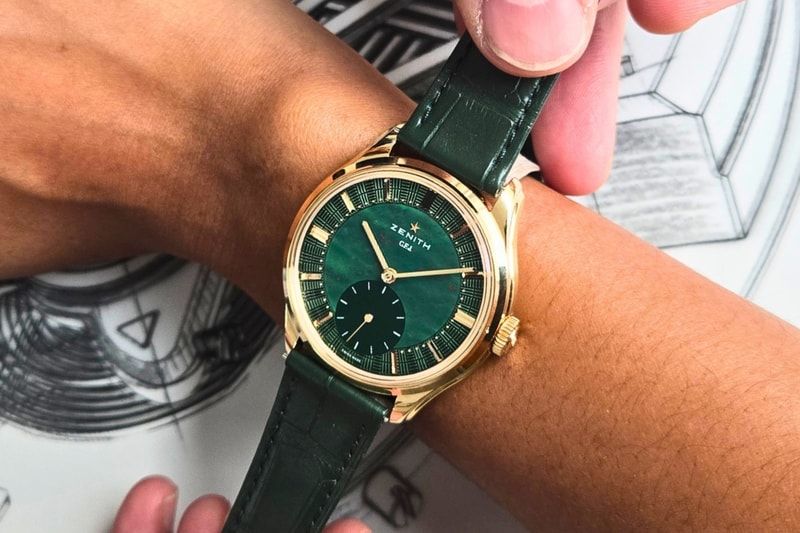
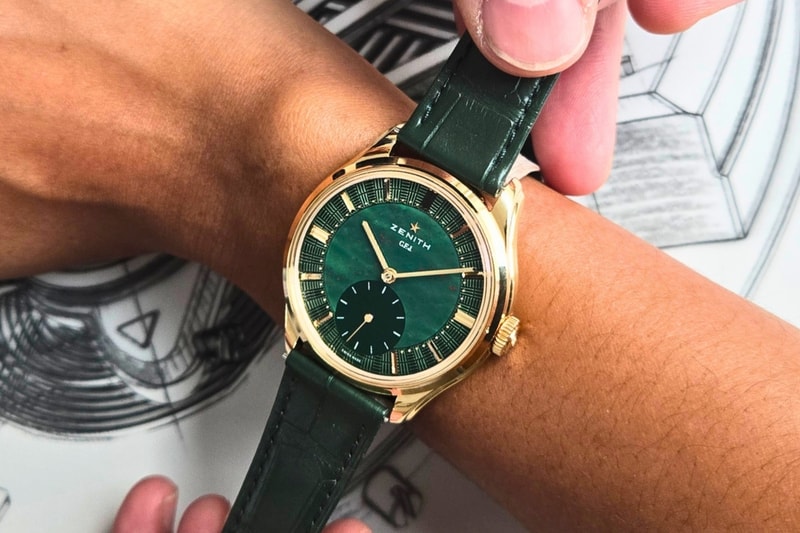
The story of the G.F.J. continues to evolve in 2026. For this year’s Watches and Wonders in Geneva, Zenith introduced two highly limited headline models: one in 18k yellow gold with a bloodstone dial, and another in pure Tantalum paired with a deep, polished black onyx dial. “It started with the case. We wanted to introduce yellow gold, which we didn't currently have in the collection,” Marietta recalls. The team quickly settled on bloodstone for the main dial, not merely because green and gold pair effortlessly together, but because the gemstone possesses an uncharacteristic energy that stands out from the ubiquitous malachite dials seen in luxury watchmaking.
Standing alongside this radiant iteration of the G.F.J watch is the Tantalum edition. Tantalum is notoriously difficult to use in watchmaking because its dense, highly ductile nature rapidly dulls and destroys standard machining tools, turning the execution of sharp case angles and fine hand-engravings into an incredibly punishing, labor-intensive ordeal. This piece marks the first time Zenith has ever produced a watch in tantalum — a challenge magnified by the G.F.J.’s case design, which features sharp inner angles on the step chamfers and bezel. Compounding this, the G.F.J. initials on the crown had to be engraved entirely by hand for each of the 20 limited pieces, as the metal prevents standard automated machining.

Looking to the future, Marietta tells Hypebeast that the macro-strategy for the G.F.J. line will systematically rotate through three distinct “rhythms” – a core collection model (such as this year's yellow gold novelty), a highly precious material interpretation (like the tantalum and black onyx edition) and independent collaborations. Given the collection's inherent independent spirit and haute horlogerie positioning, Zenith intends to further this spirit by collaborating with independent watchmakers from around the world. “We have more to come,” he teases.
After a few blind guesses, Marietta offered us a little more insight into the upcoming collaboration they have down the pipeline. Although he could not reveal which independent watchmaker they will be partnering with next, he showed us a concept sketch. “When I met with the watchmaker, before I could even pitch the idea, he asked, ‘Are you here to propose something with the Calibre 135?’,” Marietta recalled, adding that the independent watchmaker is a huge admirer of chronometers from the '40s and '50s. “It was the perfect match,” he stated.
Click here to view full gallery at Hypebeast
Source: Hypebeast — Read original