
Inside the Unconventional World of Goat Therapy, Where Talking Is Entirely Optional
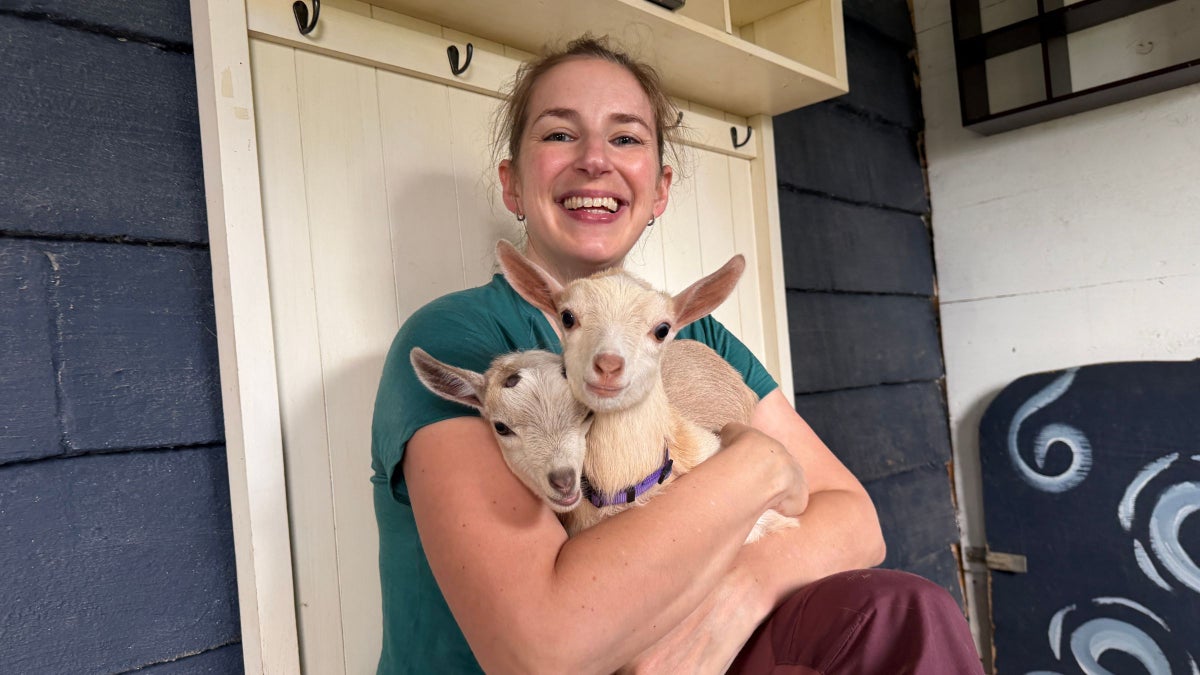
I like my therapist a lot but she doesn’t nibble my sleeve, or smell like cedar chips, or press her tiny nub-horns into my arm, which—no offense—really diminishes her ability to make me feel immediately great. Sure, she’s brilliant and supp…
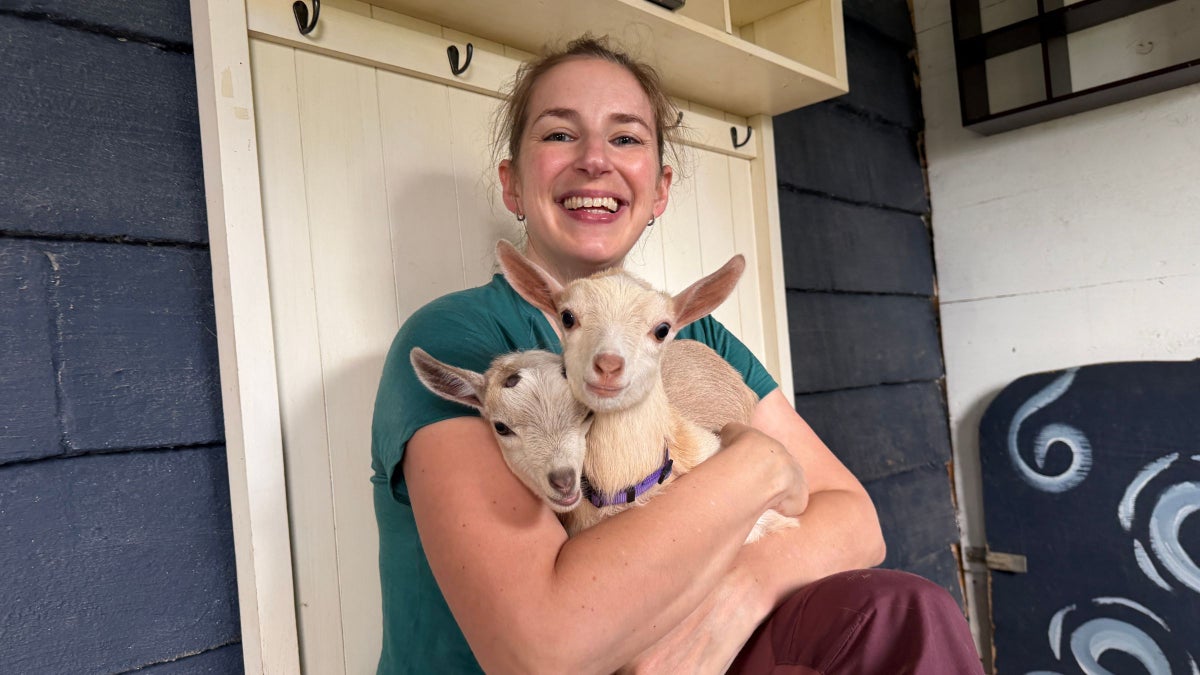
I like my therapist a lot but she doesn’t nibble my sleeve, or smell like cedar chips, or press her tiny nub-horns into my arm, which—no offense—really diminishes her ability to make me feel immediately great. Sure, she’s brilliant and supportive and leaves me with clarity, but clarity can hurt. Sometimes you just want to feel better instantly, rather than, you know, be better over time. So when I found a farm near me that offers Therapy With Goats ($50/hour), I immediately booked a session—failing to realize that you’re supposed to BYO therapist and thus discuss your life while sitting in a pile of baby goats, a process that truly strikes a balance between improving your life both long-term and right now. I did not BYO therapist, but I did meet goats.
Of course, you don’t need to do goat therapy at Blue Sky Farms. You can also do goat life coaching, or goat yoga, or goat parties, or you can invent your own goat-friendly event and the farm’s owner, Ellen Beaulieu, will almost certainly be on board. She’s a warm and smiling 50-something with long silver hair, buff arms, and an unnerving ability to stare into your soul, like she’s already your oldest friend. Ellen met me in her farm’s driveway and led me through a barn with the doors thrown wide, the sunlight casting her miniature donkey, Jack, in an almost haloed glow. “I used to drive by farms and think, oh my god, if someone would just let me sit there,” she said, guiding me past a burbling waterfall and pond, where a frog sat shining on a rock. But working farms are busy and dangerous, so when she bought Blue Sky in 2013, her goal was to make it look like what people want a farm to look like—and then invite them in.
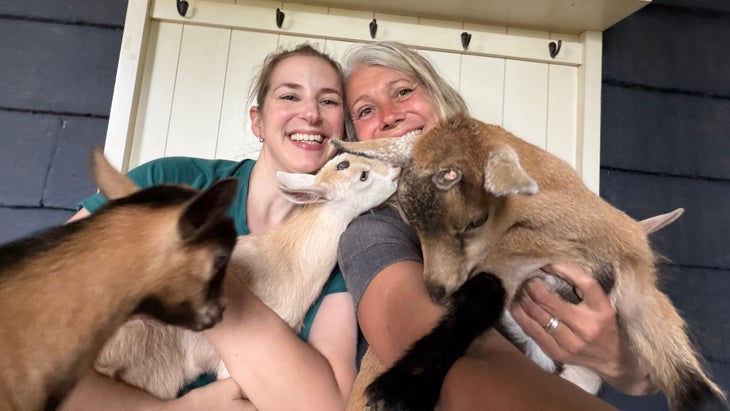
The goat space, as it were, is an airy room off the side of the barn, with painted blue-and-white walls and a floor strewn with fragrant hay—which was, at the moment, teeming with what appeared to be 10,000 three-week-old kids, who swarmed our legs when we walked in. (In fact, there were only seven of them, a fact I know because Ellen told me, and not because they slowed down enough for me to count.) We sat together on a bench and the kids immediately started launching onto our laps, crowding for space and butting our chins. Even when clients don’t come specifically for therapy, Ellen tells me, “They still walk out of here and go, ‘wow, that’s so therapeutic.’ That’s no accident.”
“How do you make it therapeutic?” I asked.
She didn’t seem to hear me, and anyway, there was too much to do—the goats piled onto my lap, soft and slightly dusty, surprisingly warm, and when I wrapped my forearms around them they seemed to melt into my chest. They had little pointy faces, their lips nibbled impossibly fast. Their ears were speckled with miniature white spots. A cream-colored kid licked my nose repeatedly, its tongue the size of a fingertip.
“Which one reminds you of you?” Ellen asked.
I looked around. A brown kid was launching against my crossed legs, making it almost onto my lap before sliding sideways again and again. I scooped him up with one palm and he settled on my thighs. I related to him, but it took a moment to figure out why. “This one,” I said, “because he doesn’t mind falling. I think I’m like that too. I get to do cool things in life because I’m not so afraid of falling down.”
No sooner had I said it than Ellen’s eyes twinkled, and I saw what she had done. Ask someone about themselves, and they’ll tell you something they already know. But by observing the goats, feeling a connection and putting words to it, they have the chance to learn something new.
Herself, Ellen relates to a little boy named Chia—“He’s an equalizer,” she says; “He helps everyone get along.” Her visitors are mostly women—not just therapists and their clients, but also friend groups, a skydiving club, moms and daughters of all ages. The other day, Ellen walked in and found adult sisters lying on their stomachs, laughing uproariously. They weren’t even petting the goats; just being near them was enough. Blue Sky’s yoga classes sell out fast—25-person sessions, with clients from as far as Iowa and Indiana. (Ellen launched the classes a decade ago, expecting the trend to be short-lived, but this will be her ninth summer straight.) Goat yoga isn’t just a gimmick, she explained to me: the goats are a means to the ends of yoga, and vice versa. People who are self-conscious in their bodies feel freer, more present, because everyone’s attention is on the goats, not them. As for goats, they’re prey animals, and can get nervous when too many people reach out (“They’re like, I’m not sure why you want me so bad!”) But when visitors are doing yoga, the goats feel comfortable to approach.
Ellen’s ultimate goal for the farm is to turn it into a sober living home for women, who would help to care for the animals. The idea came from her personal experience helping a friend with sobriety. “I checked her into 13 rehabs in 10 years,” she explained, “and realized how broken the system really is. After 30 days in rehab, you can start to see past your addiction, but that’s when the hard work begins.” A residential home would offer support longer-term—plus, you know, fun with goats. (Her friend, who’s lived on the farm on and off, has now been sober for several years.)
I’d been looking forward to my own therapy later that week; there was something I wanted to bring up that had kept my heart clenched for days. But now, sitting there, it felt much easier to wait. I wrapped my arms tight around a tan-and-white goat, kissed its flicking ears, inhaled its goaty smell. Beside me, Ellen did the same with Chia, who seemed to have melted entirely into her chest. “People don’t always need to talk through their problems,” she said softly, head tucked, as if telling a secret to the goat alone. “Sometimes, they just need space to breathe.”
The post Inside the Unconventional World of Goat Therapy, Where Talking Is Entirely Optional appeared first on Outside Online.
Source: Outside Online — Read original